

The data AI can't find: why proprietary supplier intelligence is your new audit trail
By Frances Atkins, Co-founder and CEO, givvable
Every week brings a new AI model that is faster, cheaper and better at reading the internet than the last. That is exactly why the internet is losing its value as a source of advantage. When every model can read the same public web, what it knows stops being special.
For procurement, compliance and risk leaders, and for the platforms that serve them, the question is no longer which AI tool to use. It is which data still holds its value when AI can summarize everything else. Our view is that the edge comes from combining two things: the context only your organization holds, and proprietary supplier intelligence that no general model can reach.
Public data isn't an advantage, and neither is a workflow on its own
Anyone can pull public data today. Company registers, sanctions lists, annual reports and news are a search away, and an AI model will summarize them in seconds. That is useful, but if a competitor can ask the same model the same question and get the same answer, you own nothing.
Software faces the same pressure. Microsoft CEO Satya Nadella has described business applications as "CRUD databases with a bunch of business logic", and says that logic is moving to AI agents. For platforms serving procurement and risk teams, a workflow alone is becoming easier to replicate. What stays defensible is a workflow that runs on data nobody else holds. As Bain's 2025 Technology Report puts it: "Your data is your moat."
The market has already started to price this in. The Wall Street Journal reported that OpenAI's licensing deal with News Corp is worth more than US$250 million over five years. The Columbia Journalism Review reports that Reddit is paid about US$60 million a year by Google and around US$70 million by OpenAI for access to its content. Those deals aren't paying for software. They're paying for data AI companies can't get any other way.
Buyers face the same question. Asking a chatbot about your suppliers gives you what everyone else gets. The advantage comes from bringing your own context (your suppliers, spend, criteria and policies) to proprietary intelligence a general AI can't reach, inside the systems and agents you already use.
What's in the proprietary data givvable makes available to clients?
A general AI might find that a supplier holds a certification. What it can't tell you is what that credential proves about the supplier's risk, and what it leaves uncovered. That is the layer givvable builds and makes available to its clients, in six steps.
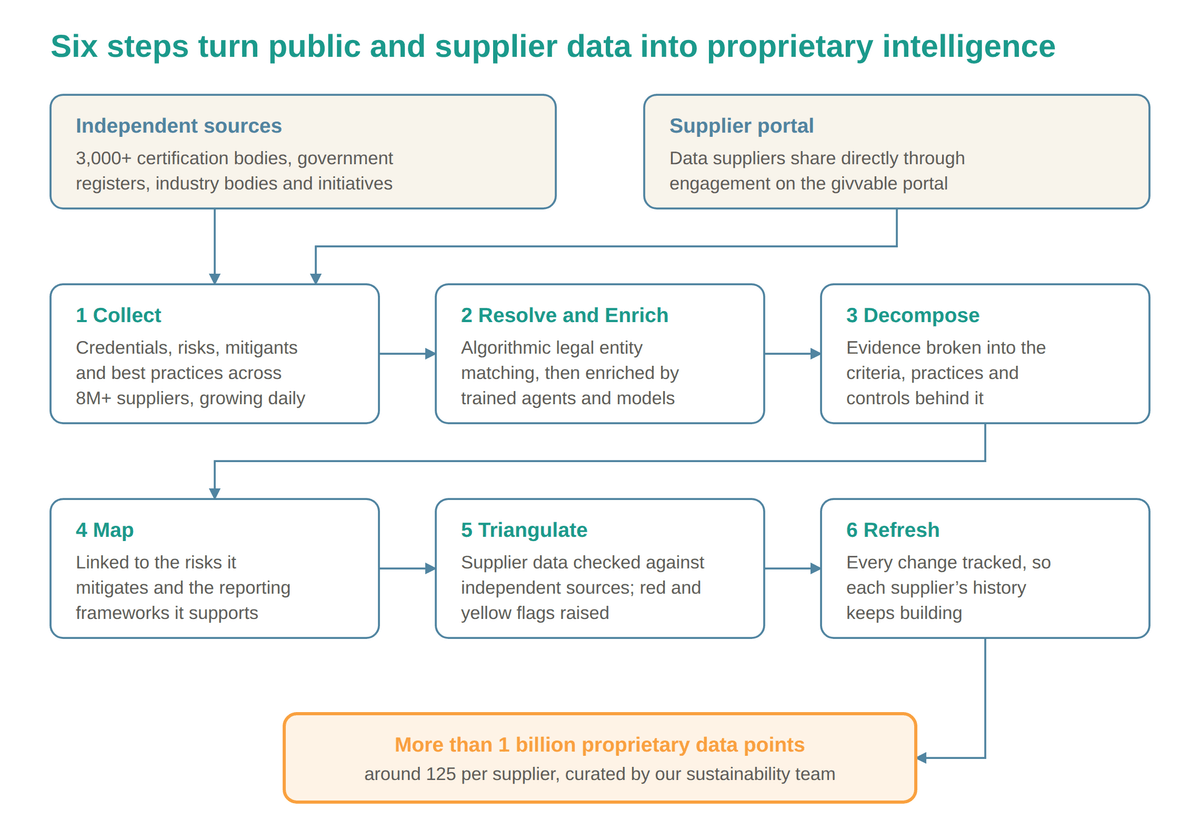
1. Collect. The foundation is verifiable credentials (certifications, accreditations, registrations, memberships and commitments), identified from more than 3,000 sources, supplemented by information directly from suppliers themselves through engagement with givvable's free supplier portal, ENGAGE.
2. Resolve and Enrich. Credential data is notoriously unstructured and incomplete. givvable's matching algorithms work to link each credential to the right legal entity, so it attaches to the relevant supplier rather than one with a similar name. givvable then enriches supplier information using specially trained agents and models.
3. Decompose. Every piece of evidence, from a credential to a supplier's own policy, is broken down into the criteria and controls it demonstrates, and is compared against recognized best practice.
4. Map. Those criteria are mapped using proprietary givvable models to the supply chain risks they mitigate, and to frameworks, policies and objectives organizations report against.
5. Triangulate. A single source rarely tells the whole story. A supplier's own statement says one thing, a certification body another, and a regulator's register or a news report something else again. givvable cross-checks independent sources about the same supplier, weighing where they agree and flagging where they conflict. Red and yellow flags sit alongside the credentials, surfacing where risk is exposed rather than mitigated.
6. Refresh. Every data point is tracked as it changes: credentials issued, renewed, lapsed or withdrawn, new risks emerging and mitigants put in place. Every change adds to each supplier's history.
The result is more than 1 billion proprietary data points, an average of around 125 for every supplier. The data has been developed by givvable's sustainability team, with more than 25 years of combined experience, and curated, corrected and enriched over more than five years. Cross-checking many independent signals, rather than trusting any one of them, is what makes each record defensible in an audit. In the age of AI, that curation is also protection. givvable's proprietary data is made available only to clients, through the platform, API and MCP server, rather than published on the open web.
Here's what that looks like in practice. Take a supplier holding ISO 14001. To be certified, it must have run an environmental management system, identified its legal obligations and environmental impacts, and passed an independent audit by an accredited body, with ongoing surveillance audits. So givvable can show which environmental management risks that supplier has evidenced controls for. Just as importantly, ISO 14001 says nothing about labor practices, human rights or emissions targets. Those gaps show up too, so buyers see what's covered and what still needs attention.
Data that changes, and remembers
Supplier risk isn't fixed, because suppliers aren't. They grow, enter new markets, and are sold or acquired. Certifications lapse, governance changes and legal actions emerge.
That history can't be easily backfilled. Reports get replaced, web pages come down and registers are updated, so last year's evidence is often gone for anyone who wasn't collecting it. McKinsey's May 2026 research makes the same point: datasets built up over years are the hardest advantage for competitors to copy.
A snapshot tells you where a supplier stands today. A timeline shows direction: certifications that keep lapsing, adverse findings that are building, or a supplier that has steadily improved.
Your context, meeting verified intelligence
The real value appears when two kinds of data meet: an organization's own context, which only it holds, and givvable's proprietary supplier intelligence, which general AI can't reach. Users bring their supplier lists, spend, tender criteria and policies. givvable matches each supplier and overlays the intelligence that fits the question being asked. The result is an answer specific to that organization. It can support tasks like:
Evaluating tenders. A council shortlisting bidders for a waste services contract can test each respondent's claims against independent evidence. Those claims include certifications, governance issues and modern slavery statements. Bidders are then evaluated against the council's own criteria, not a generic checklist. For a tendering platform, this becomes built-in verification at the point of evaluation.
Construction and infrastructure packages. A head contractor assembling packages for a road or rail project may engage dozens of subcontractors across several tiers. Each one can be cross-checked against the project's contract requirements before contracts are signed, and history shows whether an issue is a one-off or a pattern. For a contractor management platform, this puts credentials alongside the compliance data users already rely on.
Aligning suppliers to your own policy. A business with a supplier code of conduct can check each supplier against it and see which requirements are met, which aren't, and the evidence behind each finding. For a procurement platform, this turns a static policy document into a live, evidenced assessment.
What this means for platforms
For procurement, risk, credit and contractor management platforms, givvable delivers this intelligence directly into their existing product through an API or MCP server. There's no internal data build. Their customers get verified, audit-ready supplier intelligence without leaving the platform. The platform gets a capability grounded in proprietary data its customers can't get by plugging in a general AI, combined with the data and workflows they already run on the platform.
What comes next
givvable has pre-launched its MCP server to existing customers. It lets them query verified supplier intelligence directly from the AI tools they already use.
The AI race won't be won by whoever reads the public internet fastest. It will be won by organizations that combine their own context with proprietary intelligence worth trusting: deep, triangulated, verified and ready for audit.
See how much of your supply base we cover
The best way to understand the difference is to see it on your own data. Send us your supplier list, or a sample of your customers' suppliers if you're a platform, and we'll run a free match rate analysis. It shows how many of your suppliers givvable covers, along with an example data row so you can see the depth of intelligence behind each match.
Request a match rate analysis or contact hello@givvable.com.
About givvable
givvable is a supplier sustainability intelligence platform, providing organizations with independently sourced, continuously maintained supplier data across ESG performance, compliance risk, and supply chain traceability. givvable delivers 60x more coverage of Asian supply chains than Western-focused ESG data providers, and integrates directly into enterprise data architectures, procurement platforms, and AI agent workflows, including via MCP.